
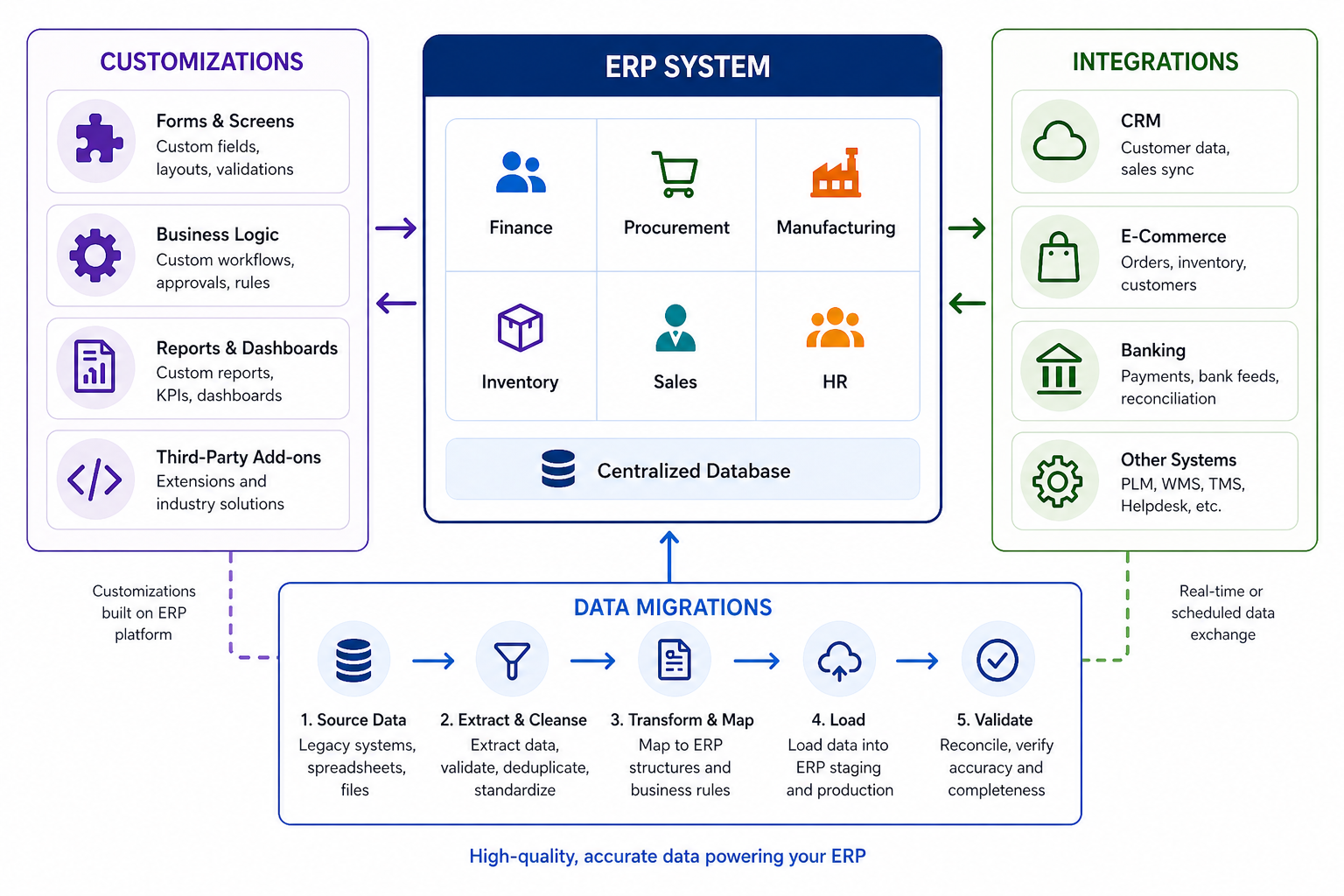
There are many reasons ERP implementations can take longer and cost more than anticipated. For example, weak executive sponsorship, insufficient organizational change management, treating as an IT-only project, and unreasonable timelines to name a few.
However, we have long believed that the top 2 (now 3) activities that have the greatest potential to disrupt an ERP implementation are:
- Customizations
- Data Migrations
- Integrations (due to rising acceptance of Cloud ERP)
Customizations
Customization is modifying, extending, or circumventing core ERP software functionality to fit specific business needs. Customizations are risky, costly, time-consuming, and create long-term maintenance burdens. They should only be entertained when necessary to satisfy a legal/regulatory requirement or provide a strategic competitive advantage for the business. “This is how we’ve always done it” by itself is not a valid justification.
Our Advice
- Minimize customizations by establishing a “standard functionality over customization” policy.
- Create a governance board to allow customization only when it meets previously established criteria (e.g., competitive advantage, legal requirement).
- Spend substantially more time testing customizations than standard functionality.
Data Migrations
Data Migration is the process of transferring data from legacy systems to the new ERP. It is a high-risk, time-consuming activity for ERP implementation. The “garbage in, garbage out” concept fully applies here.
Our Advice
- Scrutinize the data to migrate (e.g., do not try to convert transaction history).
- Start early in the project and assign data ownership to a project lead from the business.
- Cleanse and validate the data thoroughly.
- Perform multiple mock data migration iterations before going live.
- Phase the actual migration of data focusing on static data before dynamic data.
- Spend substantially more time testing data migration than standard functionality.
Integrations
Integration is the process of connecting an ERP with another mission critical software application to enable automation and preserve a “single source of truth”. It is common where other best of breed or custom applications are in use such as industry specific order entry, asset maintenance, e-commerce platforms, and banking feeds. With the growth of Cloud ERP, integration has become increasingly disruptive due to API limitations, multiple potential points of failure, limited customization, and reliance on a vendor’s ecosystem.
Our Advice
- Carefully choose the integration method being sure to balance data volumes, timeliness, vendor compatibility, and auditability.
- Spend substantially more time testing integrations than standard functionality.